


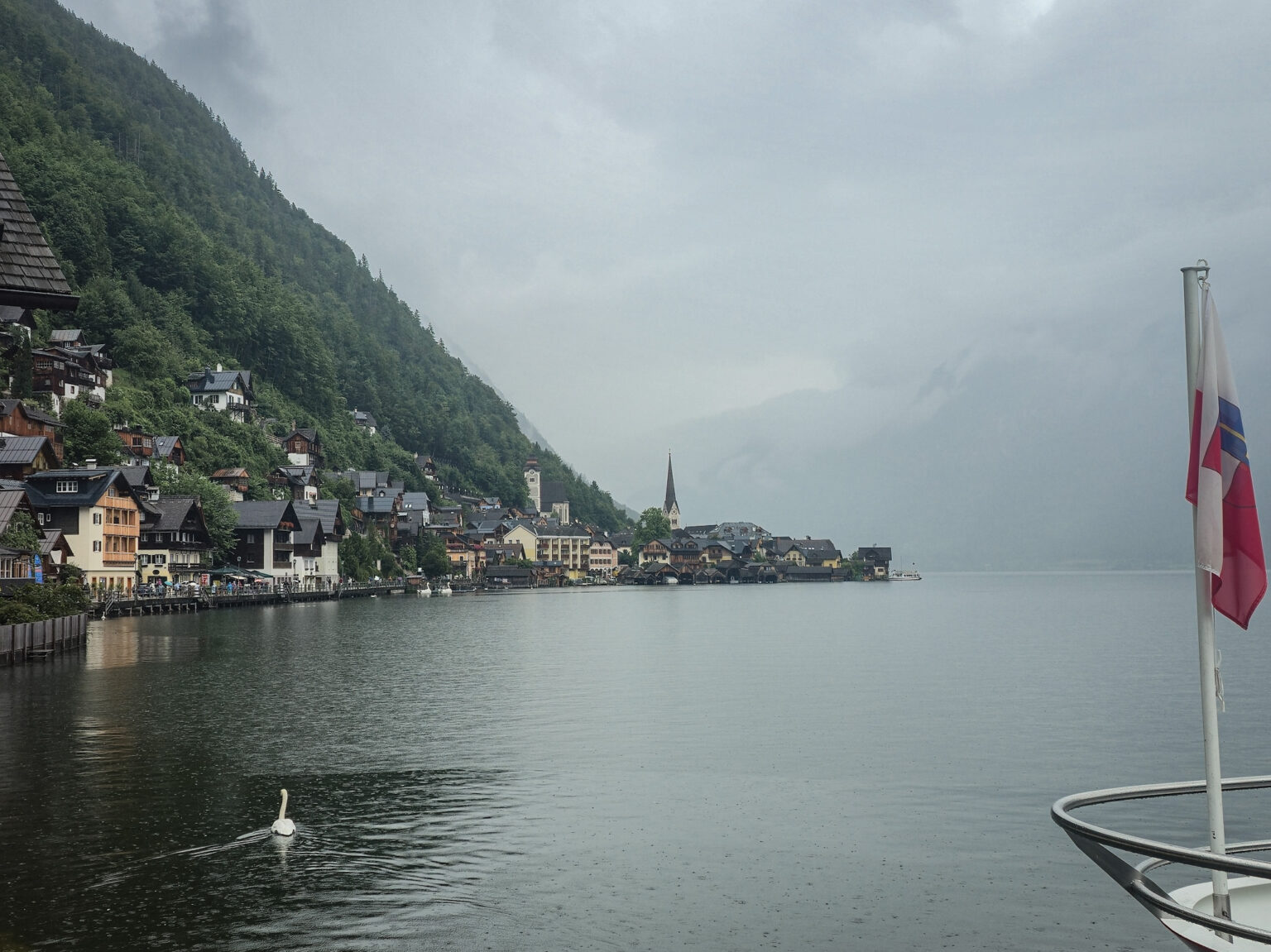
The Morning of the Decision: When Plans Fall Through
“Seriously, Sarah? Look at that!” Lena’s voice wavered between gallows humor and genuine disappointment. My best friend pointed toward the window of our accommodation, where heavy raindrops were racing down the glass in irregular streaks.
Outside, the wind whipped the rain almost horizontally against the pane. The majestic Alpine peaks that had greeted us so proudly yesterday had completely vanished. They were hidden behind a thick, impenetrable curtain of low-hanging, slate-gray clouds.
I wrapped both hands around my hot coffee mug, seeking warmth, and looked around the room. The mood at the breakfast table was as gloomy as the weather. My husband, Markus, frowned, staring skeptically at his smartphone as if refreshing the weather app would magically summon a sun icon. No such luck. A 90% chance of rain. All day long.
Our children stirred their cereal with a listlessness that spoke volumes. We had been planning this trip for months. Hallstatt. The village that looks like a flawless movie set on Instagram. The village that seems to glow under an azure sky on every postcard.
“There’s no such thing as bad weather, only unsuitable clothing,” I chimed in. I tried to put as much confidence into my voice as possible, even though I felt a small pang in my heart looking outside. But there was something else: a burning curiosity.
I had read so much about “overtourism” in Hallstatt. Reports of alleys where you have to push through like it’s rush hour, and the noise of hundreds of rolling suitcases on the cobblestones. In my head, a picture was forming that was far more exciting than the sunny postcard version.
“Just imagine,” I said, leaning forward, “today, this world-famous village might belong to us alone. No crowds, no selfie sticks waving in our faces. Just us, the lake, and the silence.”
Lena looked at me doubtfully, a faint smile creeping onto her face. “You mean we’re trading the perfect photo for the perfect adventure?”
I nodded. “Exactly. Grab your rain jackets. We’re going.”
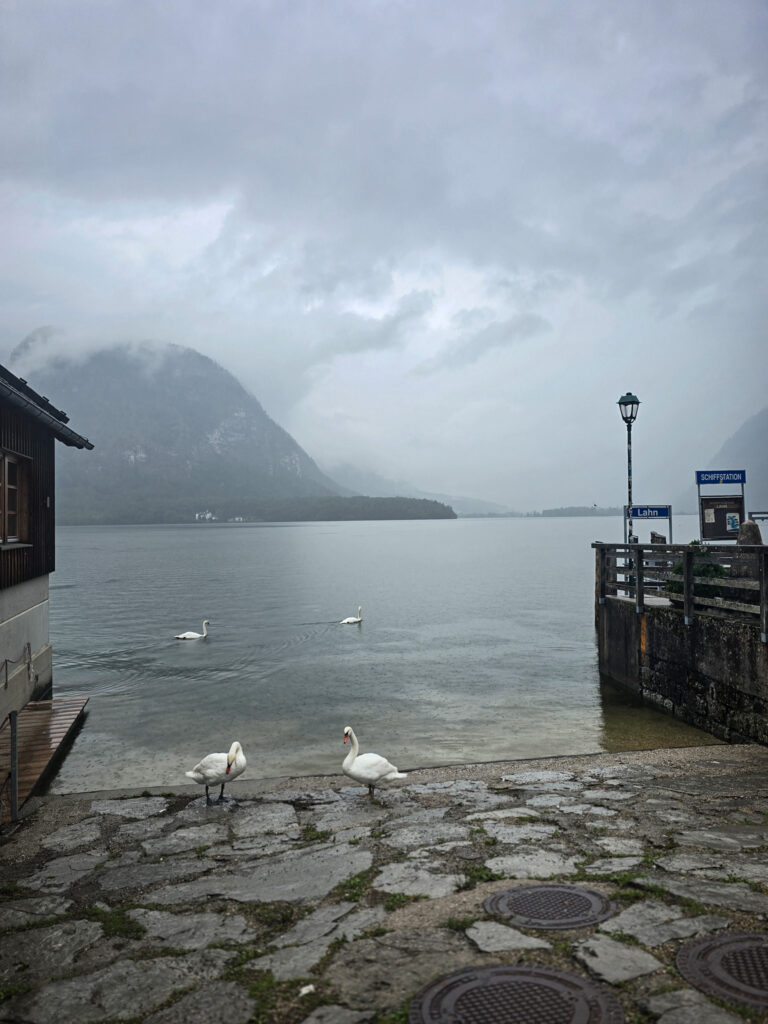
The Drive into the Unknown: When the Journey Changes the Destination
The car doors clicked shut with a heavy, wet thud. As Markus set the windshield wipers to the highest setting, a very special atmosphere began to fill the car—the kind that only arises when a family decides to defy the weather.
The air inside smelled of waterproofed rain jackets, damp dog paws—our loyal companion couldn’t be left behind, of course—and the anticipation of an adventure whose outcome we didn’t yet know.
We left Salzburg behind and dove into the heart of the Salzkammergut. The drive from Salzburg to Hallstatt usually takes about an hour and a half, but on this day, it felt like a journey to another time. We consciously decided against the highway and chose the scenic route via Lake Wolfgang and Bad Ischl.
“Look, the lake is steaming!” one of the kids shouted from the backseat. And indeed, Lake Wolfgang did not lie there in its usual postcard-blue. It had frozen into a giant, emerald-green surface, over which delicate veils of mist danced like ghostly beings. The steep rock faces of the Schafberg no longer appeared gray through the rain, but deep black and majestic.
Lena, who already had her camera ready in the passenger seat, took her first snapshots through the rain-streaked side window. “It has something melancholic, almost dramatic,” she muttered while looking at the display. The usual cheerfulness of the summer landscape had given way to a raw, honest beauty.
The deeper we ventured into the Traunviertel, the narrower the valleys became. The waterfalls, which usually hang like fine silver threads from the cliffs, had swollen into thundering white ribbons due to the persistent rainfall. The roar of the water was perceptible as a deep rumble even with the windows closed.
Just before reaching Bad Goisern, the ultimate question loomed:
Would we even find a parking spot?
Or had thousands of others had the same “crazy” idea as we did?
Markus tapped nervously on the steering wheel as the GPS relentlessly guided us closer to our destination. But when we finally reached the tunnel that reveals the view of Lake Hallstatt, something magical happened.
The world suddenly went quiet. No honking traffic, no tour buses struggling through the narrow curves. Just us, the road, and the dark, deep water of the lake, welcoming us like an open book.
Hallstatt lay before us, shrouded in a shroud of clouds—and in that moment, I knew: the decision was absolutely right.
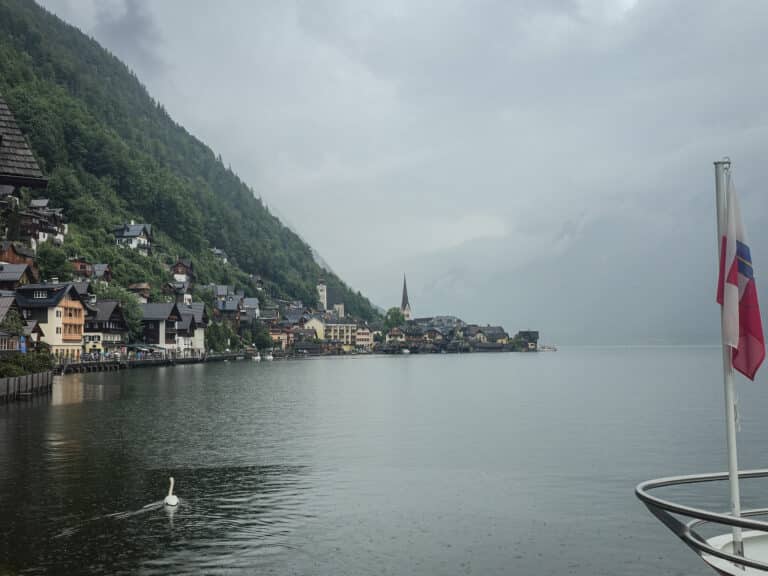
The Arrival: A Village Breathes
As Markus brought the car to a halt in parking lot P2, a moment of complete silence filled the vehicle. The usual scene we knew from the news and social media—the image of dozens of tour buses lined up like colorful caterpillars—was entirely missing.
We were almost alone. Only a few other cars stood lost in the rain, their windows fogged up as if they were nodding to each other: “You too, then?”
We pulled up our hoods, opened our umbrellas, and stepped out. The first thing that hit me wasn’t the cold, but the air. It was so incredibly pure that it almost hurt to breathe it in. It smelled of wet limestone, the sharp aroma of the surrounding coniferous forests, and that deep, dark freshness of the lake.
The path from the parking lot toward the center usually leads across a promenade where you have to weave through a slalom of selfie sticks and souvenir hunters. But today? Today, the asphalt belonged to us. Every step on the wet ground created a soft, splashing sound that echoed off the steep rock faces of the Salt Mountain.
“Sarah, look at the swan family,” Lena whispered, pointing toward the shore. A proud pair of swans glided across the mirror-smooth, almost black water, completely unfazed by the rain. There were no wakes from excursion boats, no cheering from the viewing platforms. Nature had reclaimed its space.
As we drew closer to the historic village center, the scenery began to shift. The famous wooden houses, which huddle so closely against the cliffs as if they were afraid of sliding into the lake, appeared much more solid in the rain. The wet wood had darkened, giving the facades an almost venerable depth.
We reached the first bend that offers the classic view of the church tower. Lena stood frozen in her tracks. She didn’t even raise her camera. She simply stared at the mist, which hung in the gutters of the houses like tufts of cotton wool.
“It’s not a museum,” she said softly, “it’s a home.” And that was exactly it. Without the colorful masses of day-trippers, we suddenly saw the details: the lovingly tended herb gardens in tiny backyards, the moss-covered stairways, and the old wooden doors behind which the light of warm lamps shimmered through the windows.
We hadn’t just reached Hallstatt. We had landed in a story as old as the salt in the mountains above us—and the rain was the curtain that shielded us from the modern world.
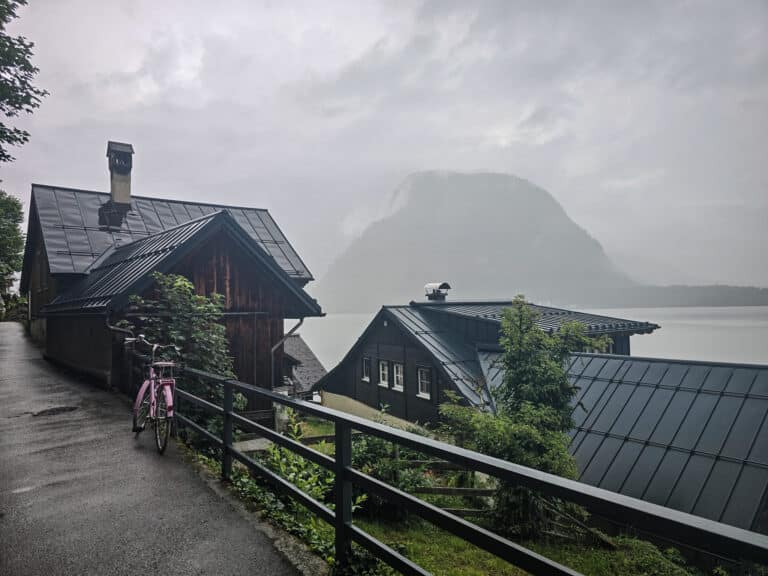
The Heart of the Village: In the Veins of History
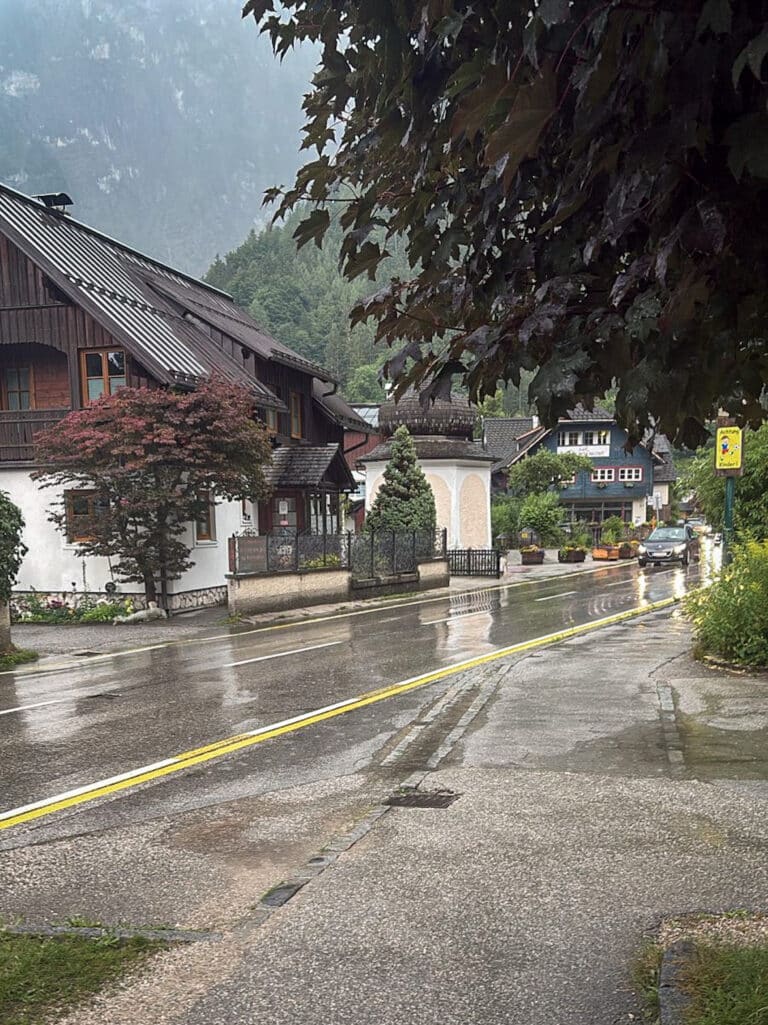
We left the lakeside promenade behind and turned into the narrow alleys that wind up the mountain like veins. Here, away from the main thoroughfares, Hallstatt unfolded its very own, almost intimate melody. The constant drumming of the rain on the shingled roofs mingled with the gurgling of water as it shot from ornately decorated gargoyles directly into the narrow gutters on the ground.
It was fascinating: normally, Hallstatt is a place you look at. But in the rain, it was a place you listened to.
“Mommy, look! The stairs are a waterfall!” My son pointed to one of the steep stone staircases leading up between the houses. The rainwater cascaded down the steps in small falls, glistening like liquid silver in the pale light. We decided not to take the easy path, but to climb exactly those stairs.
The higher we climbed, the quieter it became. Markus and I exchanged a look—it was one of those rare moments of absolute peace that you miss so often in everyday family life. At the top, by a small wooden balcony overhanging the alley, we met an elderly woman. She wore a thick cardigan and was just lighting a small lantern next to her front door, even though it was only early afternoon.
“Grüß Gott,” she said in a voice that sounded as calm as the lake below us. She didn’t seem surprised to see us up here in the pouring rain. “A good day to pause and reflect, isn’t it?”
We stopped for a moment and chatted. She told us she had lived here for over seventy years. She had seen the village transform from a lonely place for salt miners into a global phenomenon. But days like this, she said, were the most precious to her. “When the rain comes, the village belongs to us locals again—and to the guests who take their time.”
As we walked on, I no longer felt like a tourist. I felt like a guest who had been granted a private glimpse into a millennia-old sanctuary.
We passed the Ossuary (Beinhaus) and the small church. The cemetery, with its wrought-iron grave crosses and perfectly tended flower beds, did not seem gloomy in the fog, but comforting. Droplets of water hung like diamonds on the rose petals. Lena kept falling behind to take macro shots. “This light,” she raved, “no shadows, no reflections. Just pure, honest colors.”
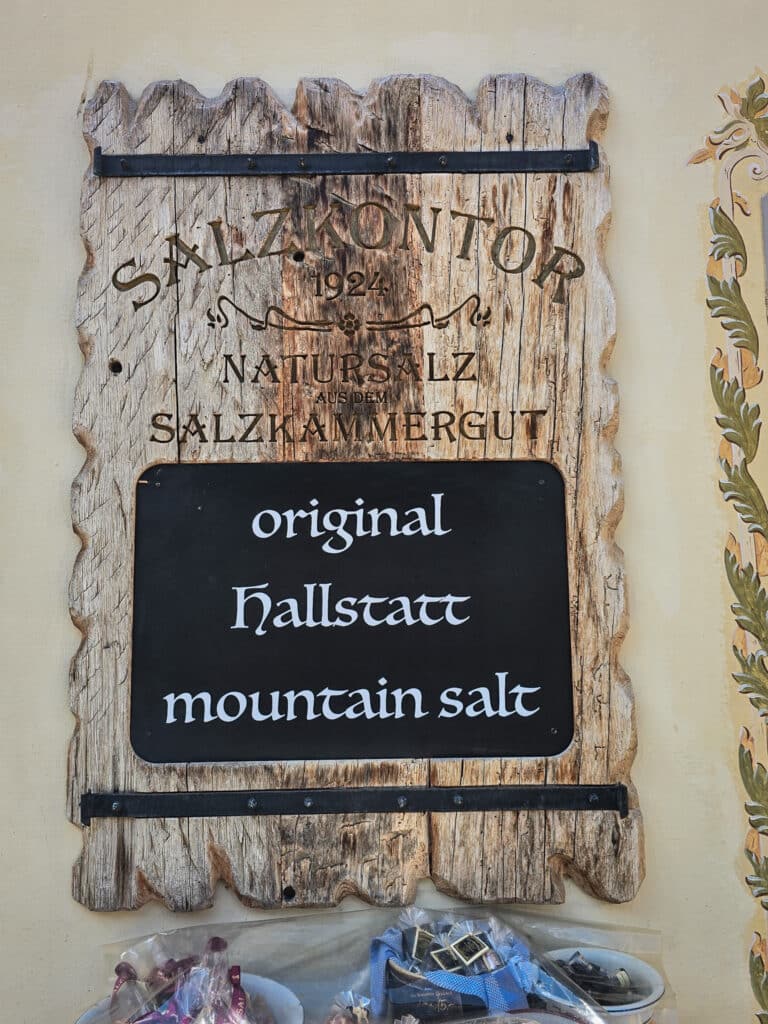
We reached the market square. The colorful houses all around stood like silent guardians in the rain. The displays of the small craft shops—from hand-harvested salt to carved wooden figures—looked like treasures in a showcase behind the fogged-up windowpanes.
We felt our jackets getting heavier, but no one thought of turning back. We were caught in the rhythm of the village.
Culinary Refuge: Where Time Stands Still Over Kaiserschmarrn
Eventually, the rain began to take its toll. Despite our high-quality jackets, the damp cold slowly crept up our ankles, and the children’s noses had turned a vibrant shade of pink.
It was that specific moment when you long for nothing more than the scent of roasted coffee beans and the warmth of a burning stove.
We found sanctuary in one of those cafés that feel as though they’ve been plucked straight from a 19th-century novel. The moment we pressed down on the heavy door handle, a wall of comfort greeted us: it smelled of cinnamon, melted butter, and the tart aroma of damp loden wool.
“Table for five?” asked a waitress in a Dirndl, her smile so warm that you immediately forgot the gray skies outside. She led us to a massive oak table right by the window. The glass was slightly fogged, and outside, you could see the silhouettes of passersby scurrying past the colorful house fronts with their heads tucked in.
“Two large servings of Kaiserschmarrn with plum roaster, please,” Markus ordered without even opening the menu. For the children, there was hot chocolate topped with a mountain of whipped cream so firm it sat on the cup like a small snowy peak.
When the cast-iron pan finally arrived—the shredded pancake still steaming, baked to a golden brown, and dusted with a fine layer of powdered sugar—a reverent silence fell over the table. It is hard to describe, but in that moment, with the rain drumming against the panes, this simple dish tasted of pure security. Every bite was a small rebellion against the weather.
Lena pulled out her notebook. “You know,” she said, brushing a lock of hair from her forehead, “if we had radiant sunshine today, we probably wouldn’t even be sitting here. We’d be racing from one photo spot to the next, always glancing at the clock to catch the best light.”
She was right. The rain was our “decelerator.” It gave us permission to just sit there for two hours, talking and watching the steam rise from our drinks. We observed the locals at the regular’s table (Stammtisch) nearby, debating wood prices and the lake’s water levels in a deep dialect. We were no longer just observers of a backdrop; for one afternoon, we were part of the village community.
By the time we finally set out again, our umbrellas had dried, our fingers were warm, and our batteries—both our cameras’ and our own—were fully recharged. The rain outside had turned into a fine, almost tender drizzle, bathing the village in an even softer light.
Above the Clouds: When the Mist Swallows the World
Despite the cozy warmth of the café, curiosity lured us back outside. We wanted to go higher. Markus was skeptical at first: “Do you really think we’ll see anything up there? It’s a total whiteout.” But Lena and I were in agreement: today of all days, the view from the Salt Mountain had to be something truly special.
We decided to take the Salzbergbahn funicular. The glass-walled car glided almost silently up the steep rock face. It was a surreal feeling: with every meter of altitude we gained, the village below sank deeper into the gray until we eventually plunged into a solid white wall of clouds. It felt as if we were leaving the world as we knew it behind.
Arriving at the top, at the “Skywalk”—the spectacular viewing platform hovering 350 meters above the rooftops of Hallstatt—we were met with a sight none of us will ever forget.
Normally, crowds jostle here to snag the perfect panorama of the lake and mountains. Today, we were the only ones at the tip of the steel platform. Before us, there was no blue, no green, and no distant peaks. There was only the white. The mist was so thick you could barely see the end of the platform. We were literally standing in the middle of nowhere.
“It feels like the end of the world,” Lena whispered, stepping right up to the railing.
And then, for a tiny instant, the curtain tore open. For just a few seconds, the wind cleared the view directly downward. Like looking through a keyhole, we saw the tiny, dark roofs of Hallstatt and the deep, almost black water of the lake. It wasn’t a panorama—it was a revelation. This brief, fleeting moment was a thousand times more intense than any postcard view in radiant sunshine.
We stood up there in the fine drizzle, which settled like a cool film on our faces. It wasn’t cold; it was invigorating. It was the moment we all realized: the beauty of Hallstatt lies not in its perfection, but in its mutability.
On the way back to the funicular, we passed the old defensive tower, which now houses a restaurant. These thick walls have defied every storm and downpour for centuries. We paused for a moment, listening to the wind whistling through the wet branches of the sycamore trees.
Up here, between the history of salt mining and the untamable power of nature, we felt small and yet infinitely free.
The Farewell: The Glow Behind the Gray
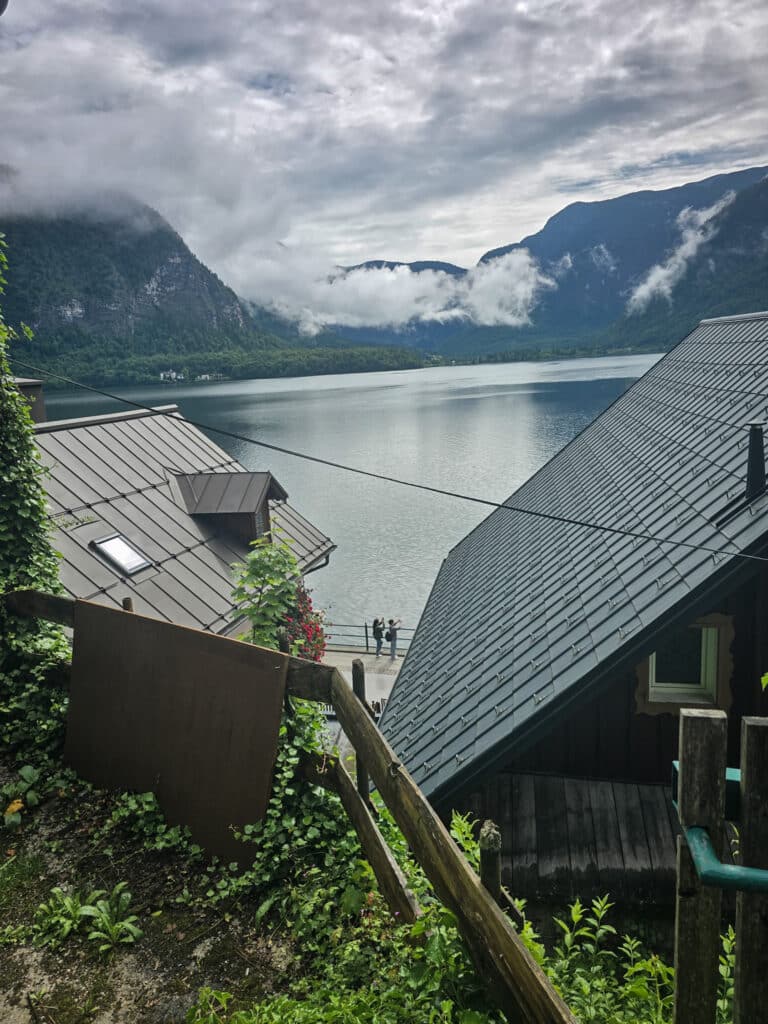
As we finally began our descent and reached the familiar lakeside paths of Hallstatt, the light had changed. It was already late afternoon. The harsh gray of the morning had given way to a soft, almost violet shimmer that settled over the lake.
The rain was now little more than a fine mist, softening the edges of the world.
We walked more slowly. No one really wanted to leave this cocoon of silence and security. We stopped one last time at the Market Square. The children, whose jackets had finally reached their limit, looked exhausted but strangely content. There was no trace of the morning’s grumbling.
Markus brushed the water from his shoulders and looked across the lake. “You know,” he said thoughtfully, “I think if it had been sunny, we would have only seen the surface. Today, we caught the core.”
He spoke exactly what we were all feeling. We had experienced Hallstatt without its mask. Without the glittering staging that attracts millions of people. We had seen the Hallstatt of the locals, the Hallstatt of history and the forces of nature. We had learned that rain is not an obstacle, but an invitation—an invitation to pause, to look closely, and to feel.
At the bridge at the northern end of the village, Lena took her last photo. It wasn’t a picture of the church. It was a close-up of a small, wet bench by the lakeshore with a single, autumnal leaf stuck to it. “That is my Hallstatt,” she said, putting her camera away.
The walk back to the car was marked by an almost solemn mood. We climbed in, turned the heater to full blast, and soon the windows fogged up from the inside. As we left the tunnel and the lights of the village faded in the rearview mirror, a deep sense of satisfaction took hold.
We drove home with wet shoes. Our pant legs were sticking to our calves, and Lena’s hairstyle had long since lost its battle with the humidity. But our eyes were glowing. We hadn’t just spent a day at a World Heritage site; we had received a lesson in happiness.
We had learned that the most beautiful moments often wait where you least expect them: behind a wall of mist, under an old umbrella, and in the gentle rhythm of falling drops.
Hallstatt in the rain wasn’t our backup plan.
It was our gift.
And as we rolled back through the darkening night of the Salzkammergut towards Salzburg, we knew: we would be back. Perhaps even exactly when the weather app shows a 90% chance of rain again.
This day proved that Hallstatt is a place for every season and every weather condition. If you want to discover the true soul of this village, you should have the courage to open your umbrella when everyone else stays in their hotel. It is worth it.
Do you want to experience Hallstatt just as magically and relaxed as we did?
Leave the planning and traffic behind. On a private tour, your personal driver will take you to the hidden corners of this World Heritage village—no matter the weather. Enjoy the luxury of a personal driver who will show you the true soul of Hallstatt.
Book your exclusive Hallstatt experience here!